Have you determined whether your products are covered by the Food Traceability List (FTL)?

1201 2nd Ave, Suite 915
Seattle, WA 98101
206-219-3703



FSMA 204 is FDA’s Food Traceability Rule, requiring enhanced traceability records for foods on the Food Traceability List (FTL). With the July 20, 2028 compliance deadline approaching, food companies should be evaluating their processes, data, and supply chain readiness now.
Whether you’re just getting started or advancing your traceability program, this hub provides practical guidance on FSMA 204 requirements, implementation strategies, compliance milestones, and supply chain collaboration best practices.
We’ll be updating this page regularly with new content and updated information if/when the FDA makes further updates to FSMA 204.
 The FSMA 204 Food Traceability Rule is intended to help the food industry trace certain foods more quickly and accurately when questions arise. For foods on the FDA’s Food Traceability List, the rule introduces additional recordkeeping requirements designed to make it easier to identify affected products, support faster recalls, and better protect consumers.
Preparing for FSMA 204 can feel more manageable when companies give themselves time to understand what applies to their business, review current processes, and coordinate with supply chain partners. Starting now can help reduce last-minute pressure, uncover data or process gaps early, and build a more practical path toward compliance before the July 20, 2028 deadline.
 Understanding FSMA 204 requires more than reading the regulation—it requires understanding how traceability works in real-world food supply chains. The iFoodDS team includes experienced food safety, traceability, and supply chain professionals who actively participate in industry initiatives and standards organizations, including GS1 and the Produce Traceability Initiative (PTI), helping shape practical approaches to traceability and data exchange.
For organizations seeking personalized guidance, iFoodDS offers FSMA 204 consulting services through New Era Partners, our consulting division led by former FDA traceability expert and iFoodDS Chief Traceability Officer Andy Kennedy. Drawing on deep regulatory and operational experience, the team helps companies understand the real-world impact of FSMA 204, assess readiness, and develop practical compliance strategies that align with their unique operations. Learn more about iFoodDS and our traceability expertise.
 https://www.ifoodds.com/wp-content/uploads/2026/09/2027-Milestones-Featured-Image.png
1181
1331
Jenny Obranovich
/wp-content/uploads/2023/12/ifoodds-logo-tm-300x95.png
Jenny Obranovich2026-09-28 20:05:282026-09-28 20:34:05FSMA 204 Readiness Milestones: Scale Your Operations
https://www.ifoodds.com/wp-content/uploads/2026/09/2027-Milestones-Featured-Image.png
1181
1331
Jenny Obranovich
/wp-content/uploads/2023/12/ifoodds-logo-tm-300x95.png
Jenny Obranovich2026-09-28 20:05:282026-09-28 20:34:05FSMA 204 Readiness Milestones: Scale Your Operations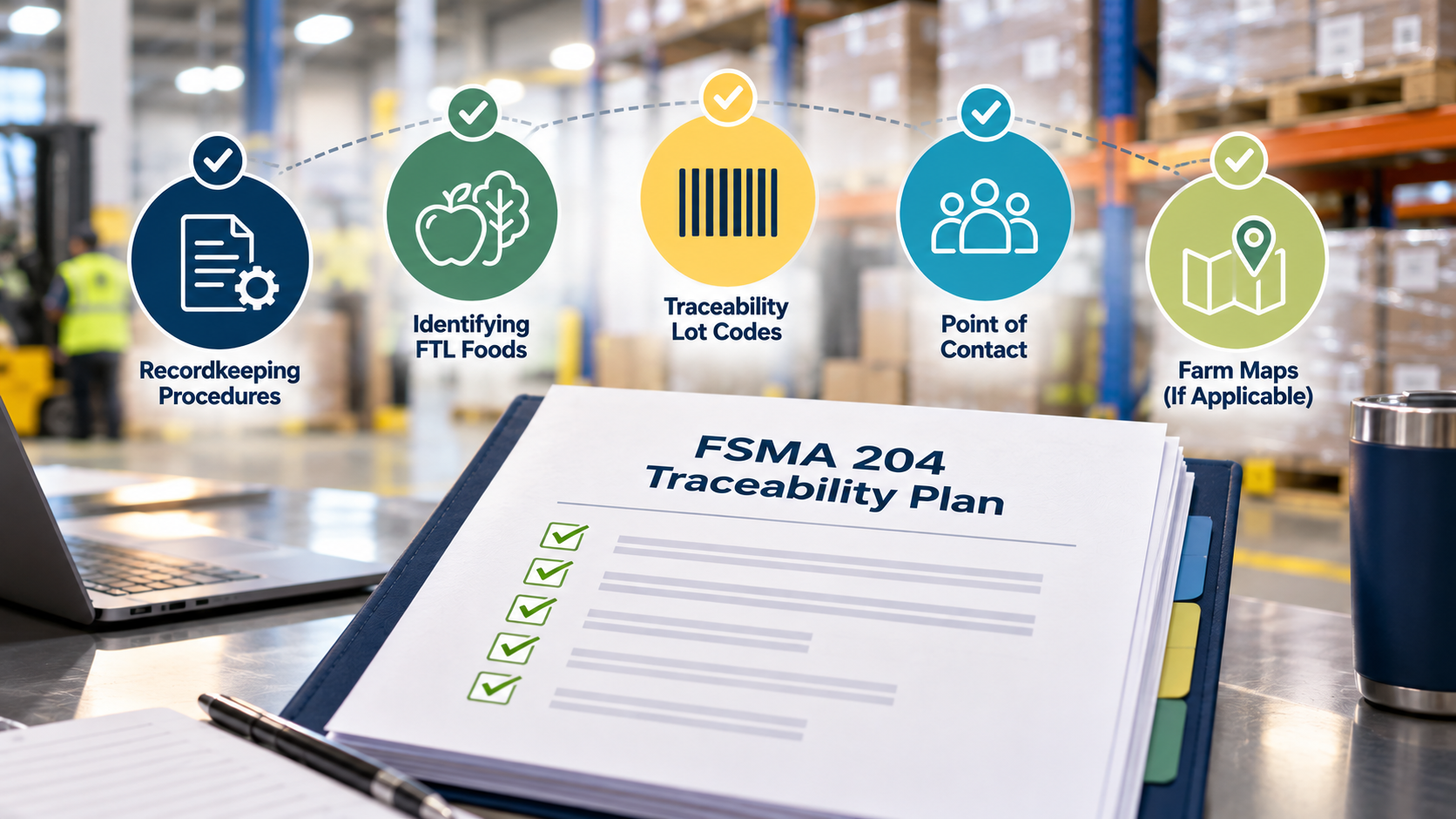 https://www.ifoodds.com/wp-content/uploads/2026/09/Trace-Plan-Article-Hero.png
940
1672
Jenny Obranovich
/wp-content/uploads/2023/12/ifoodds-logo-tm-300x95.png
Jenny Obranovich2026-09-25 19:20:312026-09-28 19:40:30What Should Your FSMA 204 Traceability Plan Include?
https://www.ifoodds.com/wp-content/uploads/2026/09/Trace-Plan-Article-Hero.png
940
1672
Jenny Obranovich
/wp-content/uploads/2023/12/ifoodds-logo-tm-300x95.png
Jenny Obranovich2026-09-25 19:20:312026-09-28 19:40:30What Should Your FSMA 204 Traceability Plan Include? https://www.ifoodds.com/wp-content/uploads/2023/08/A-Checklist-for-Choosing-the-Right-FSMA-204-Traceability-Partner-1.png
460
680
Ana Laura Alonso
/wp-content/uploads/2023/12/ifoodds-logo-tm-300x95.png
Ana Laura Alonso2026-09-21 07:08:232026-09-28 19:37:37What Should Distributors, Manufacturers, and Processors Look for in a FSMA 204 Traceability Solution Provider?
https://www.ifoodds.com/wp-content/uploads/2023/08/A-Checklist-for-Choosing-the-Right-FSMA-204-Traceability-Partner-1.png
460
680
Ana Laura Alonso
/wp-content/uploads/2023/12/ifoodds-logo-tm-300x95.png
Ana Laura Alonso2026-09-21 07:08:232026-09-28 19:37:37What Should Distributors, Manufacturers, and Processors Look for in a FSMA 204 Traceability Solution Provider? https://www.ifoodds.com/wp-content/uploads/2025/05/A-Checklist-for-Choosing-the-Right-FSMA-204-Traceability-Partner-For-Suppliers-Looking-for-a-Cost-Effective-Flexible-Compliance-Solution-to-Meet-All-Their-Customers-Requirements.png
460
680
Ana Laura Alonso
/wp-content/uploads/2023/12/ifoodds-logo-tm-300x95.png
Ana Laura Alonso2026-09-03 14:43:412026-09-21 22:16:06What Should Suppliers Look for in a FSMA 204 Traceability Solution Provider?
https://www.ifoodds.com/wp-content/uploads/2025/05/A-Checklist-for-Choosing-the-Right-FSMA-204-Traceability-Partner-For-Suppliers-Looking-for-a-Cost-Effective-Flexible-Compliance-Solution-to-Meet-All-Their-Customers-Requirements.png
460
680
Ana Laura Alonso
/wp-content/uploads/2023/12/ifoodds-logo-tm-300x95.png
Ana Laura Alonso2026-09-03 14:43:412026-09-21 22:16:06What Should Suppliers Look for in a FSMA 204 Traceability Solution Provider?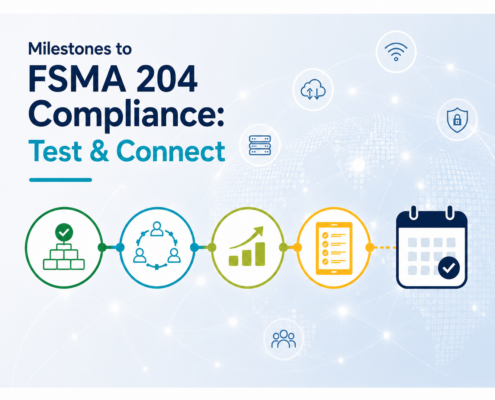 https://www.ifoodds.com/wp-content/uploads/2026/08/Milestone-2-Test-Connect-Featured-Image-1.png
1182
1331
Jenny Obranovich
/wp-content/uploads/2023/12/ifoodds-logo-tm-300x95.png
Jenny Obranovich2026-08-18 16:35:072026-09-30 18:07:44FSMA 204 Readiness Milestones: Test and Connect
https://www.ifoodds.com/wp-content/uploads/2026/08/Milestone-2-Test-Connect-Featured-Image-1.png
1182
1331
Jenny Obranovich
/wp-content/uploads/2023/12/ifoodds-logo-tm-300x95.png
Jenny Obranovich2026-08-18 16:35:072026-09-30 18:07:44FSMA 204 Readiness Milestones: Test and Connect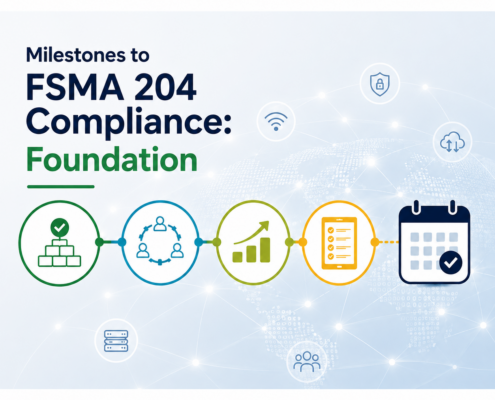 https://www.ifoodds.com/wp-content/uploads/2026/08/ChatGPT-Image-Aug-6-2026-03_52_25-PM.png
1254
1254
Jenny Obranovich
/wp-content/uploads/2023/12/ifoodds-logo-tm-300x95.png
Jenny Obranovich2026-08-06 18:46:432026-09-30 18:09:35FSMA 204 Readiness Milestones: Building the Foundation
https://www.ifoodds.com/wp-content/uploads/2026/08/ChatGPT-Image-Aug-6-2026-03_52_25-PM.png
1254
1254
Jenny Obranovich
/wp-content/uploads/2023/12/ifoodds-logo-tm-300x95.png
Jenny Obranovich2026-08-06 18:46:432026-09-30 18:09:35FSMA 204 Readiness Milestones: Building the Foundation https://www.ifoodds.com/wp-content/uploads/2026/08/ChatGPT-Image-Aug-6-2026-10_31_07-AM.png
1254
1254
Jenny Obranovich
/wp-content/uploads/2023/12/ifoodds-logo-tm-300x95.png
Jenny Obranovich2026-08-06 13:38:192026-09-30 18:33:18Key Milestones for FSMA 204 Readiness (Infographic)
https://www.ifoodds.com/wp-content/uploads/2026/08/ChatGPT-Image-Aug-6-2026-10_31_07-AM.png
1254
1254
Jenny Obranovich
/wp-content/uploads/2023/12/ifoodds-logo-tm-300x95.png
Jenny Obranovich2026-08-06 13:38:192026-09-30 18:33:18Key Milestones for FSMA 204 Readiness (Infographic) https://www.ifoodds.com/wp-content/uploads/2025/11/TraceApproved-Logo-with-white-background-space-added-1.png
733
1188
Jenny Obranovich
/wp-content/uploads/2023/12/ifoodds-logo-tm-300x95.png
Jenny Obranovich2026-08-03 11:07:242026-08-03 14:08:00Get Ready for FSMA 204 with iFoodDS’ TraceApproved™ – a New Online Learning Program Crafted by Traceability Experts
https://www.ifoodds.com/wp-content/uploads/2025/11/TraceApproved-Logo-with-white-background-space-added-1.png
733
1188
Jenny Obranovich
/wp-content/uploads/2023/12/ifoodds-logo-tm-300x95.png
Jenny Obranovich2026-08-03 11:07:242026-08-03 14:08:00Get Ready for FSMA 204 with iFoodDS’ TraceApproved™ – a New Online Learning Program Crafted by Traceability Experts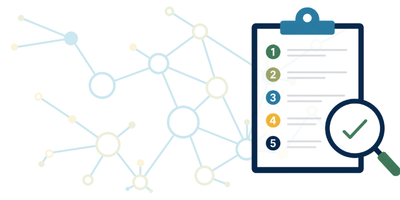 https://www.ifoodds.com/wp-content/uploads/2026/06/Website-Article-Header-image-400-x-200-px.png
200
400
Jenny Obranovich
/wp-content/uploads/2023/12/ifoodds-logo-tm-300x95.png
Jenny Obranovich2026-06-29 18:25:462026-08-28 17:26:335 Common Misconceptions About FSMA 204—and What They Mean in Practice
https://www.ifoodds.com/wp-content/uploads/2026/06/Website-Article-Header-image-400-x-200-px.png
200
400
Jenny Obranovich
/wp-content/uploads/2023/12/ifoodds-logo-tm-300x95.png
Jenny Obranovich2026-06-29 18:25:462026-08-28 17:26:335 Common Misconceptions About FSMA 204—and What They Mean in Practice https://www.ifoodds.com/wp-content/uploads/2026/05/Untitled-design.jpg
912
1600
Jenny Obranovich
/wp-content/uploads/2023/12/ifoodds-logo-tm-300x95.png
Jenny Obranovich2026-06-15 19:44:432026-08-28 17:20:13From Compliance to Capability—Making FSMA 204 Operational
https://www.ifoodds.com/wp-content/uploads/2026/05/Untitled-design.jpg
912
1600
Jenny Obranovich
/wp-content/uploads/2023/12/ifoodds-logo-tm-300x95.png
Jenny Obranovich2026-06-15 19:44:432026-08-28 17:20:13From Compliance to Capability—Making FSMA 204 Operational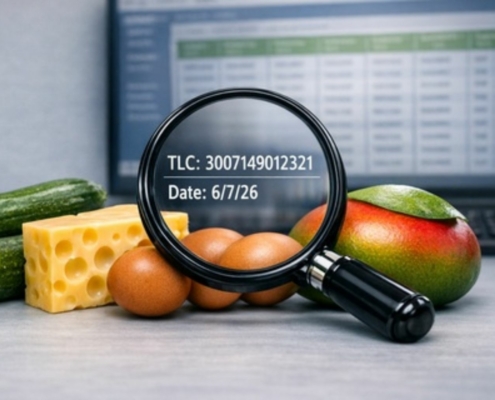 https://www.ifoodds.com/wp-content/uploads/2026/05/Hero-1536-x-1024-px.jpg
1024
1536
Jenny Obranovich
/wp-content/uploads/2023/12/ifoodds-logo-tm-300x95.png
Jenny Obranovich2026-05-27 14:26:212026-08-28 14:01:23Traceability in Action: How Data Drives Outbreak Investigations
https://www.ifoodds.com/wp-content/uploads/2026/05/Hero-1536-x-1024-px.jpg
1024
1536
Jenny Obranovich
/wp-content/uploads/2023/12/ifoodds-logo-tm-300x95.png
Jenny Obranovich2026-05-27 14:26:212026-08-28 14:01:23Traceability in Action: How Data Drives Outbreak Investigations https://www.ifoodds.com/wp-content/uploads/2026/04/warehouse-data-v2.png
1024
1536
Jenny Obranovich
/wp-content/uploads/2023/12/ifoodds-logo-tm-300x95.png
Jenny Obranovich2026-04-27 13:31:212026-08-28 17:15:41Why Data Readiness Determines Traceability Success
https://www.ifoodds.com/wp-content/uploads/2026/04/warehouse-data-v2.png
1024
1536
Jenny Obranovich
/wp-content/uploads/2023/12/ifoodds-logo-tm-300x95.png
Jenny Obranovich2026-04-27 13:31:212026-08-28 17:15:41Why Data Readiness Determines Traceability Success https://www.ifoodds.com/wp-content/uploads/2026/03/Preparing-for-FSMA-204.png
1100
2000
Jenny Obranovich
/wp-content/uploads/2023/12/ifoodds-logo-tm-300x95.png
Jenny Obranovich2026-03-25 12:01:272026-03-30 17:50:24Partners iFoodDS and TraceGains Support Supplier Readiness for FSMA 204
https://www.ifoodds.com/wp-content/uploads/2026/03/Preparing-for-FSMA-204.png
1100
2000
Jenny Obranovich
/wp-content/uploads/2023/12/ifoodds-logo-tm-300x95.png
Jenny Obranovich2026-03-25 12:01:272026-03-30 17:50:24Partners iFoodDS and TraceGains Support Supplier Readiness for FSMA 204 https://www.ifoodds.com/wp-content/uploads/2026/01/shutterstock_2550133599-scaled.jpg
1375
2560
Jenny Obranovich
/wp-content/uploads/2023/12/ifoodds-logo-tm-300x95.png
Jenny Obranovich2026-01-19 19:29:152026-08-28 13:08:54ASNs Sent Using EDI Advance Traceability, Support FSMA 204 Compliance
https://www.ifoodds.com/wp-content/uploads/2026/01/shutterstock_2550133599-scaled.jpg
1375
2560
Jenny Obranovich
/wp-content/uploads/2023/12/ifoodds-logo-tm-300x95.png
Jenny Obranovich2026-01-19 19:29:152026-08-28 13:08:54ASNs Sent Using EDI Advance Traceability, Support FSMA 204 Compliance https://www.ifoodds.com/wp-content/uploads/2025/08/9-Common-Questions-Retailers-Foodservice-Operators-and-Distributors-Ask-About-FSMA-204.png
460
680
Jenny Obranovich
/wp-content/uploads/2023/12/ifoodds-logo-tm-300x95.png
Jenny Obranovich2025-12-05 18:10:162026-08-06 14:38:48FSMA 204: Who’s Covered and Who’s Not
https://www.ifoodds.com/wp-content/uploads/2025/08/9-Common-Questions-Retailers-Foodservice-Operators-and-Distributors-Ask-About-FSMA-204.png
460
680
Jenny Obranovich
/wp-content/uploads/2023/12/ifoodds-logo-tm-300x95.png
Jenny Obranovich2025-12-05 18:10:162026-08-06 14:38:48FSMA 204: Who’s Covered and Who’s Not https://www.ifoodds.com/wp-content/uploads/2025/09/Mixed-Cut-Fruit-scaled.jpg
2560
2560
Jenny Obranovich
/wp-content/uploads/2023/12/ifoodds-logo-tm-300x95.png
Jenny Obranovich2025-09-12 14:03:282025-09-17 15:48:34Keeping Track: How to Maintain Traceability Records for FSMA 204
https://www.ifoodds.com/wp-content/uploads/2025/08/9-Common-Questions-Retailers-Foodservice-Operators-and-Distributors-Ask-About-FSMA-204.png
460
680
Ana Laura Alonso
/wp-content/uploads/2023/12/ifoodds-logo-tm-300x95.png
Ana Laura Alonso2025-08-20 14:23:462025-08-20 17:52:569 Common Questions Enterprise Retailers, Foodservice Operators, and Distributors Ask About FSMA 204
https://www.ifoodds.com/wp-content/uploads/2025/09/Mixed-Cut-Fruit-scaled.jpg
2560
2560
Jenny Obranovich
/wp-content/uploads/2023/12/ifoodds-logo-tm-300x95.png
Jenny Obranovich2025-09-12 14:03:282025-09-17 15:48:34Keeping Track: How to Maintain Traceability Records for FSMA 204
https://www.ifoodds.com/wp-content/uploads/2025/08/9-Common-Questions-Retailers-Foodservice-Operators-and-Distributors-Ask-About-FSMA-204.png
460
680
Ana Laura Alonso
/wp-content/uploads/2023/12/ifoodds-logo-tm-300x95.png
Ana Laura Alonso2025-08-20 14:23:462025-08-20 17:52:569 Common Questions Enterprise Retailers, Foodservice Operators, and Distributors Ask About FSMA 204 https://www.ifoodds.com/wp-content/uploads/2025/08/FSMA-204-Compliance-Answers-to-the-Top-Questions-from-Fresh-Food-Suppliers.png
460
680
Ana Laura Alonso
/wp-content/uploads/2023/12/ifoodds-logo-tm-300x95.png
Ana Laura Alonso2025-08-08 13:56:052025-12-08 15:32:32FSMA 204 Compliance: Answers to the Top Questions from Fresh Food Suppliers
https://www.ifoodds.com/wp-content/uploads/2025/08/FSMA-204-Compliance-Answers-to-the-Top-Questions-from-Fresh-Food-Suppliers.png
460
680
Ana Laura Alonso
/wp-content/uploads/2023/12/ifoodds-logo-tm-300x95.png
Ana Laura Alonso2025-08-08 13:56:052025-12-08 15:32:32FSMA 204 Compliance: Answers to the Top Questions from Fresh Food Suppliers https://www.ifoodds.com/wp-content/uploads/2025/07/The-Road-to-FSMA-204-Compliance-Challenges-Ahead-but-Solutions-in-Reach.png
460
680
Ana Laura Alonso
/wp-content/uploads/2023/12/ifoodds-logo-tm-300x95.png
Ana Laura Alonso2025-07-29 13:07:082026-08-27 17:56:45The Road to FSMA 204 Compliance: Challenges Ahead, but Solutions in Reach
https://www.ifoodds.com/wp-content/uploads/2025/07/The-Road-to-FSMA-204-Compliance-Challenges-Ahead-but-Solutions-in-Reach.png
460
680
Ana Laura Alonso
/wp-content/uploads/2023/12/ifoodds-logo-tm-300x95.png
Ana Laura Alonso2025-07-29 13:07:082026-08-27 17:56:45The Road to FSMA 204 Compliance: Challenges Ahead, but Solutions in Reach https://www.ifoodds.com/wp-content/uploads/2025/05/Now-Is-the-Time-Why-Forward-Thinking-Food-Suppliers-Are-Moving-Ahead-with-Digital-Traceability.png
460
680
Ana Laura Alonso
/wp-content/uploads/2023/12/ifoodds-logo-tm-300x95.png
Ana Laura Alonso2025-05-09 18:55:112025-05-12 19:44:17Now Is the Time: Why Forward-Thinking Food Suppliers Are Moving Ahead with Digital Traceability
https://www.ifoodds.com/wp-content/uploads/2025/05/Now-Is-the-Time-Why-Forward-Thinking-Food-Suppliers-Are-Moving-Ahead-with-Digital-Traceability.png
460
680
Ana Laura Alonso
/wp-content/uploads/2023/12/ifoodds-logo-tm-300x95.png
Ana Laura Alonso2025-05-09 18:55:112025-05-12 19:44:17Now Is the Time: Why Forward-Thinking Food Suppliers Are Moving Ahead with Digital Traceability https://www.ifoodds.com/wp-content/uploads/2025/01/FSMA-204-Countdown-One-Year-to-Compliance-–-Are-You-Ready.png
460
680
Ana Laura Alonso
/wp-content/uploads/2023/12/ifoodds-logo-tm-300x95.png
Ana Laura Alonso2025-01-20 13:24:072026-08-28 13:38:39FSMA 204 Countdown to Compliance – Are You Ready?
https://www.ifoodds.com/wp-content/uploads/2025/01/FSMA-204-Countdown-One-Year-to-Compliance-–-Are-You-Ready.png
460
680
Ana Laura Alonso
/wp-content/uploads/2023/12/ifoodds-logo-tm-300x95.png
Ana Laura Alonso2025-01-20 13:24:072026-08-28 13:38:39FSMA 204 Countdown to Compliance – Are You Ready? https://www.ifoodds.com/wp-content/uploads/2025/01/Navigating-FSMA-204-Progress-Challenges-and-the-Road-Ahead-.png
460
680
Ana Laura Alonso
/wp-content/uploads/2023/12/ifoodds-logo-tm-300x95.png
Ana Laura Alonso2025-01-07 12:58:362025-01-07 13:01:12Navigating FSMA 204: Progress, Challenges, and the Road Ahead
https://www.ifoodds.com/wp-content/uploads/2025/01/Navigating-FSMA-204-Progress-Challenges-and-the-Road-Ahead-.png
460
680
Ana Laura Alonso
/wp-content/uploads/2023/12/ifoodds-logo-tm-300x95.png
Ana Laura Alonso2025-01-07 12:58:362025-01-07 13:01:12Navigating FSMA 204: Progress, Challenges, and the Road Ahead https://www.ifoodds.com/wp-content/uploads/2024/07/FDA-Provides-an-Example-of-the-Electronic-Sortable-Spreadsheet-2.png
460
680
Ana Laura Alonso
/wp-content/uploads/2023/12/ifoodds-logo-tm-300x95.png
Ana Laura Alonso2024-07-01 12:18:402025-08-18 13:23:44FDA Provides an Example of the Electronic Sortable Spreadsheet
https://www.ifoodds.com/wp-content/uploads/2024/07/FDA-Provides-an-Example-of-the-Electronic-Sortable-Spreadsheet-2.png
460
680
Ana Laura Alonso
/wp-content/uploads/2023/12/ifoodds-logo-tm-300x95.png
Ana Laura Alonso2024-07-01 12:18:402025-08-18 13:23:44FDA Provides an Example of the Electronic Sortable Spreadsheet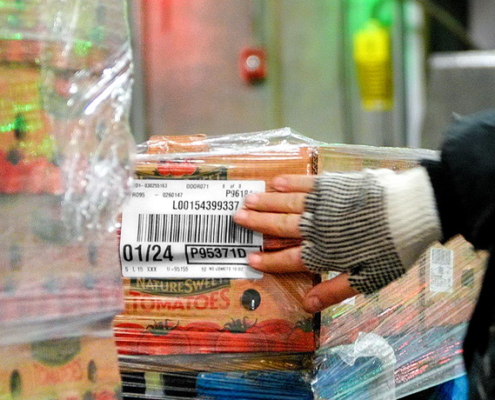 https://www.ifoodds.com/wp-content/uploads/2024/05/5-Key-Reasons-the-Traceability-Lot-Code-Is-So-Important.png
460
680
Ana Laura Alonso
/wp-content/uploads/2023/12/ifoodds-logo-tm-300x95.png
Ana Laura Alonso2024-05-20 12:30:592025-08-18 13:33:515 Key Reasons the Traceability Lot Code Is So Important
https://www.ifoodds.com/wp-content/uploads/2024/05/5-Key-Reasons-the-Traceability-Lot-Code-Is-So-Important.png
460
680
Ana Laura Alonso
/wp-content/uploads/2023/12/ifoodds-logo-tm-300x95.png
Ana Laura Alonso2024-05-20 12:30:592025-08-18 13:33:515 Key Reasons the Traceability Lot Code Is So Important https://www.ifoodds.com/wp-content/uploads/2024/04/A-Look-at-the-Changing-Landscape-of-FSMA-204-Data-Carriers.png
460
680
Ana Laura Alonso
/wp-content/uploads/2023/12/ifoodds-logo-tm-300x95.png
Ana Laura Alonso2024-04-22 13:22:112026-04-22 13:24:24A Look at the Changing Landscape of FSMA 204 Data Carriers
https://www.ifoodds.com/wp-content/uploads/2024/04/A-Look-at-the-Changing-Landscape-of-FSMA-204-Data-Carriers.png
460
680
Ana Laura Alonso
/wp-content/uploads/2023/12/ifoodds-logo-tm-300x95.png
Ana Laura Alonso2024-04-22 13:22:112026-04-22 13:24:24A Look at the Changing Landscape of FSMA 204 Data Carriers https://www.ifoodds.com/wp-content/uploads/2023/11/Going-Beyond-FSMA-204-Compliance-by-Harnessing-the-Power-of-Data-and-Technology.png
460
680
Ana Laura Alonso
/wp-content/uploads/2023/12/ifoodds-logo-tm-300x95.png
Ana Laura Alonso2023-11-13 14:50:242026-04-22 13:23:40Going Beyond FSMA 204 Compliance by Harnessing the Power of Data and Technology
https://www.ifoodds.com/wp-content/uploads/2023/11/Going-Beyond-FSMA-204-Compliance-by-Harnessing-the-Power-of-Data-and-Technology.png
460
680
Ana Laura Alonso
/wp-content/uploads/2023/12/ifoodds-logo-tm-300x95.png
Ana Laura Alonso2023-11-13 14:50:242026-04-22 13:23:40Going Beyond FSMA 204 Compliance by Harnessing the Power of Data and Technology https://www.ifoodds.com/wp-content/uploads/2023/10/Standardized-Data-and-the-Path-to-FSMA-204-Compliance.png
460
680
Ana Laura Alonso
/wp-content/uploads/2023/12/ifoodds-logo-tm-300x95.png
Ana Laura Alonso2023-10-24 17:26:392025-04-30 14:57:39Standardized Data and the Path to FSMA 204 Compliance
https://www.ifoodds.com/wp-content/uploads/2023/10/Standardized-Data-and-the-Path-to-FSMA-204-Compliance.png
460
680
Ana Laura Alonso
/wp-content/uploads/2023/12/ifoodds-logo-tm-300x95.png
Ana Laura Alonso2023-10-24 17:26:392025-04-30 14:57:39Standardized Data and the Path to FSMA 204 Compliance https://www.ifoodds.com/wp-content/uploads/2023/09/Three-Areas-Where-Youll-See-the-Greatest-Return-on-Your-FSMA-204-Investment.png
460
680
Ana Laura Alonso
/wp-content/uploads/2023/12/ifoodds-logo-tm-300x95.png
Ana Laura Alonso2023-09-14 16:45:182024-11-04 11:23:00Three Areas Where You’ll See the Greatest Return on Your FSMA 204 Investment
https://www.ifoodds.com/wp-content/uploads/2023/09/Three-Areas-Where-Youll-See-the-Greatest-Return-on-Your-FSMA-204-Investment.png
460
680
Ana Laura Alonso
/wp-content/uploads/2023/12/ifoodds-logo-tm-300x95.png
Ana Laura Alonso2023-09-14 16:45:182024-11-04 11:23:00Three Areas Where You’ll See the Greatest Return on Your FSMA 204 Investment https://www.ifoodds.com/wp-content/uploads/2023/08/4-Myths-About-FSMA-204-Dispelled.png
460
680
Ana Laura Alonso
/wp-content/uploads/2023/12/ifoodds-logo-tm-300x95.png
Ana Laura Alonso2023-08-11 13:09:202026-04-29 22:33:164 Myths About FSMA 204 Dispelled
https://www.ifoodds.com/wp-content/uploads/2023/08/4-Myths-About-FSMA-204-Dispelled.png
460
680
Ana Laura Alonso
/wp-content/uploads/2023/12/ifoodds-logo-tm-300x95.png
Ana Laura Alonso2023-08-11 13:09:202026-04-29 22:33:164 Myths About FSMA 204 Dispelled https://www.ifoodds.com/wp-content/uploads/2023/07/13-Common-Questions-Asked-About-FSMA-204.png
460
680
Jenny Obranovich
/wp-content/uploads/2023/12/ifoodds-logo-tm-300x95.png
Jenny Obranovich2023-07-17 13:27:262026-04-22 13:19:3613 Common Questions Asked About FSMA 204
https://www.ifoodds.com/wp-content/uploads/2023/07/13-Common-Questions-Asked-About-FSMA-204.png
460
680
Jenny Obranovich
/wp-content/uploads/2023/12/ifoodds-logo-tm-300x95.png
Jenny Obranovich2023-07-17 13:27:262026-04-22 13:19:3613 Common Questions Asked About FSMA 204 https://www.ifoodds.com/wp-content/uploads/2023/02/New-Era-Launch-Blog-Enterprise-Customers.jpg
460
680
Corinne Wolfe
/wp-content/uploads/2023/12/ifoodds-logo-tm-300x95.png
Corinne Wolfe2023-02-27 11:54:112026-04-22 13:14:56Get Personalized Rule 204 Guidance from a Former FDA Traceability Expert
https://www.ifoodds.com/wp-content/uploads/2023/02/New-Era-Launch-Blog-Enterprise-Customers.jpg
460
680
Corinne Wolfe
/wp-content/uploads/2023/12/ifoodds-logo-tm-300x95.png
Corinne Wolfe2023-02-27 11:54:112026-04-22 13:14:56Get Personalized Rule 204 Guidance from a Former FDA Traceability Expert https://www.ifoodds.com/wp-content/uploads/2023/01/What-Retailers-May-Not-Know-about-Rule-204-2.jpg
460
680
Corinne Wolfe
/wp-content/uploads/2023/12/ifoodds-logo-tm-300x95.png
Corinne Wolfe2023-01-19 09:00:202023-09-22 18:26:265 Things Grocery Retailers and Distributors May Not Know about FSMA Rule 204
https://www.ifoodds.com/wp-content/uploads/2023/01/What-Retailers-May-Not-Know-about-Rule-204-2.jpg
460
680
Corinne Wolfe
/wp-content/uploads/2023/12/ifoodds-logo-tm-300x95.png
Corinne Wolfe2023-01-19 09:00:202023-09-22 18:26:265 Things Grocery Retailers and Distributors May Not Know about FSMA Rule 204 https://www.ifoodds.com/wp-content/uploads/2022/12/FSMA-Rule-204-iFoodDS-Perspective-2.jpg
460
689
Corinne Wolfe
/wp-content/uploads/2023/12/ifoodds-logo-tm-300x95.png
Corinne Wolfe2022-12-01 13:17:282025-08-12 18:12:19iFoodDS’ Perspective on the Final Version of FSMA Rule 204
https://www.ifoodds.com/wp-content/uploads/2022/12/FSMA-Rule-204-iFoodDS-Perspective-2.jpg
460
689
Corinne Wolfe
/wp-content/uploads/2023/12/ifoodds-logo-tm-300x95.png
Corinne Wolfe2022-12-01 13:17:282025-08-12 18:12:19iFoodDS’ Perspective on the Final Version of FSMA Rule 204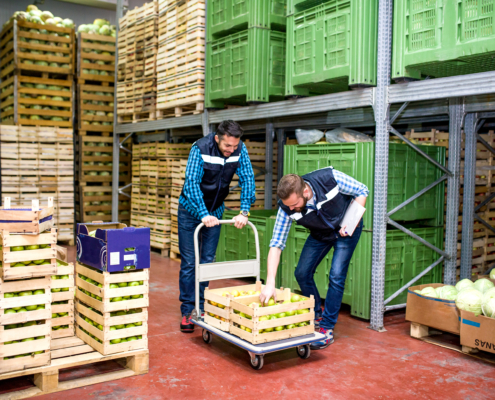 https://www.ifoodds.com/wp-content/uploads/2022/11/shutterstock_1311168845-scaled.jpg
1709
2560
Ana Laura Alonso
/wp-content/uploads/2023/12/ifoodds-logo-tm-300x95.png
Ana Laura Alonso2022-11-16 17:37:512023-10-17 13:15:03Are Your Suppliers Sending You the Information You Need to Comply with FSMA Rule 204?
https://www.ifoodds.com/wp-content/uploads/2022/11/shutterstock_1311168845-scaled.jpg
1709
2560
Ana Laura Alonso
/wp-content/uploads/2023/12/ifoodds-logo-tm-300x95.png
Ana Laura Alonso2022-11-16 17:37:512023-10-17 13:15:03Are Your Suppliers Sending You the Information You Need to Comply with FSMA Rule 204? https://www.ifoodds.com/wp-content/uploads/2022/10/Processor-KDEs-Blog.jpg
460
680
Corinne Wolfe
/wp-content/uploads/2023/12/ifoodds-logo-tm-300x95.png
Corinne Wolfe2022-10-19 09:00:592025-08-12 18:18:02How Processors Can Collect KDEs Efficiently
https://www.ifoodds.com/wp-content/uploads/2022/10/Processor-KDEs-Blog.jpg
460
680
Corinne Wolfe
/wp-content/uploads/2023/12/ifoodds-logo-tm-300x95.png
Corinne Wolfe2022-10-19 09:00:592025-08-12 18:18:02How Processors Can Collect KDEs Efficiently https://www.ifoodds.com/wp-content/uploads/2022/10/Grower-KDEs-Blog.jpg
460
680
Corinne Wolfe
/wp-content/uploads/2023/12/ifoodds-logo-tm-300x95.png
Corinne Wolfe2022-10-17 09:00:492024-02-28 23:32:53How Growers and Packer-Shippers Can Collect KDEs and Comply with FSMA Rule 204
https://www.ifoodds.com/wp-content/uploads/2022/10/Grower-KDEs-Blog.jpg
460
680
Corinne Wolfe
/wp-content/uploads/2023/12/ifoodds-logo-tm-300x95.png
Corinne Wolfe2022-10-17 09:00:492024-02-28 23:32:53How Growers and Packer-Shippers Can Collect KDEs and Comply with FSMA Rule 204 https://www.ifoodds.com/wp-content/uploads/2022/09/Retailer-KDEs-Blog-Image-2.jpg
460
680
Corinne Wolfe
/wp-content/uploads/2023/12/ifoodds-logo-tm-300x95.png
Corinne Wolfe2022-09-30 14:08:472024-03-06 22:45:40A Guide to Collecting Key Data Elements as a Grocery Retailer, Foodservice Operator, or Distributor
https://www.ifoodds.com/wp-content/uploads/2022/09/Retailer-KDEs-Blog-Image-2.jpg
460
680
Corinne Wolfe
/wp-content/uploads/2023/12/ifoodds-logo-tm-300x95.png
Corinne Wolfe2022-09-30 14:08:472024-03-06 22:45:40A Guide to Collecting Key Data Elements as a Grocery Retailer, Foodservice Operator, or Distributor
Published September 25, 2026
Learn what a FSMA 204 Traceability Plan should include, how to document your current practices, and why building and testing your plan should be a priority for 2027.

Updated September 21, 2026 (originally published August 1, 2023)
We’ve created a FSMA 204 Solution Provider Evaluation Checklist to help you compare solutions across six key areas that impact supplier network participation, traceability readiness, customer data sharing, and regulatory response.

Updated September 3, 2026 (originally published May 29, 2025)
We’ve created a FSMA 204 Solution Provider Evaluation Checklist to help you compare solutions across five key areas that impact traceability data capture, customer data sharing, FSMA 204 readiness, and regulatory response.
Updated August 24, 2026 (originally published March 21, 2024)
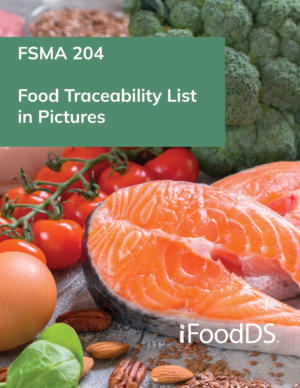
Gain a better understanding of what items are covered by reviewing our FTL in Pictures eBook, and check out the appendix for a more comprehensive list.

August 10, 2026
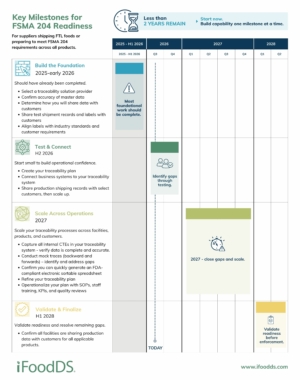
Managing traceability customer by customer creates increasing complexity and cost as your customer base expands. Suppliers can simplify operations with a single, scalable approach.
August 6, 2026
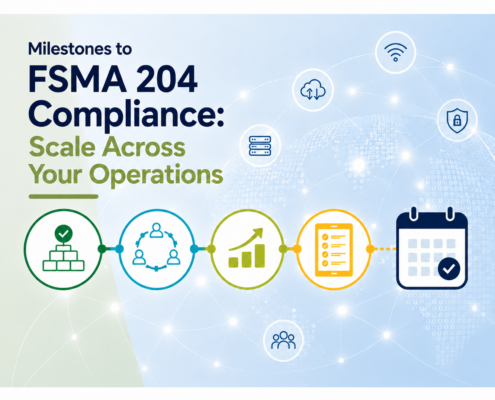
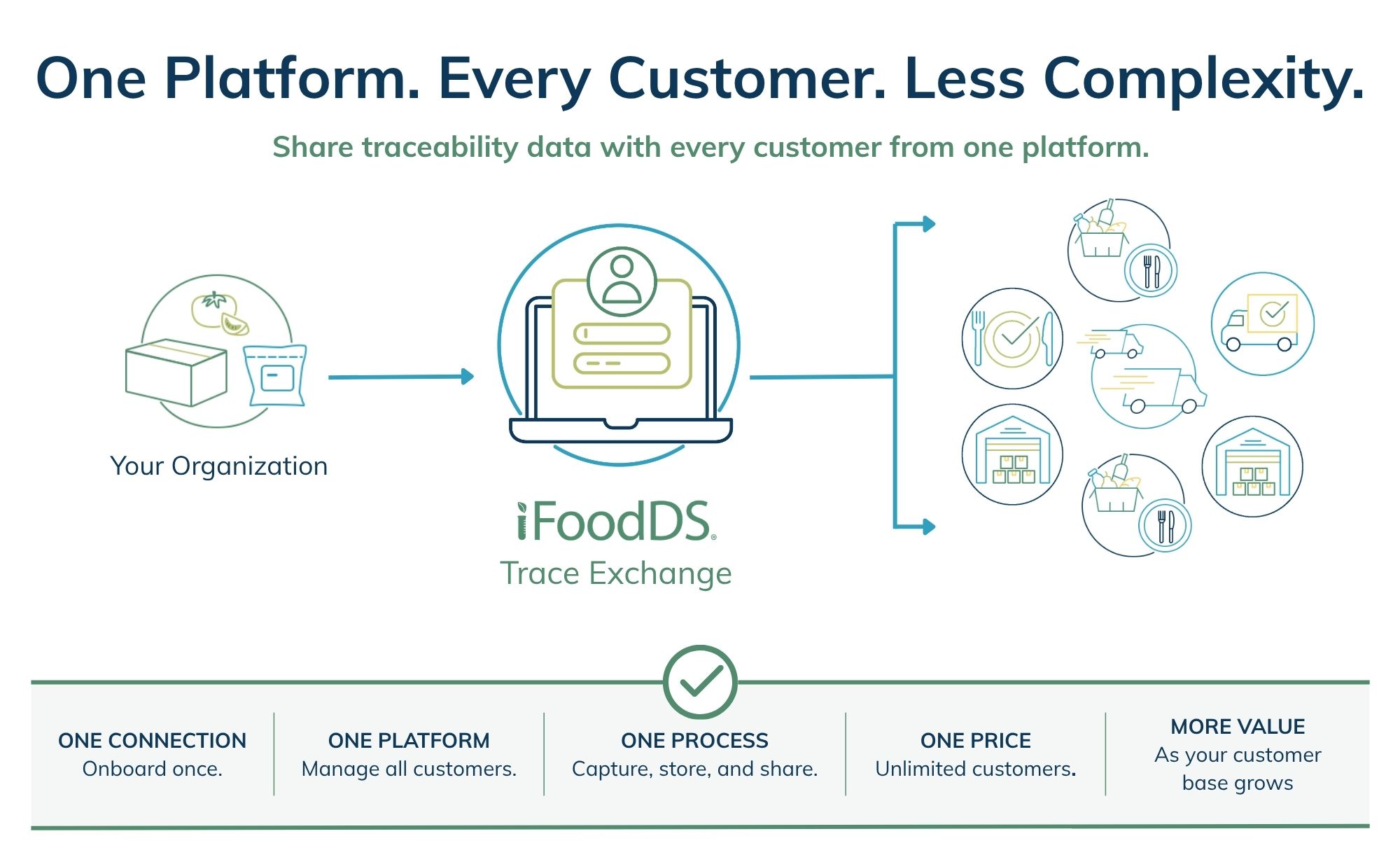
A practical roadmap that helps suppliers prioritize FSMA 204 readiness, identify what should be completed now, and build scalable traceability capabilities through phased milestones before 2028 enforcement.
August 3, 2026
With less than two years until the FSMA 204 compliance deadline, organizations are focused on strengthening traceability capabilities. But beyond collecting and maintaining data, another challenge is emerging: sharing it efficiently across a growing customer base.

July 24, 2026
Join Andy Kennedy, Chief Traceability Officer, and Claire Zoellner, Ph.D., Director of Data Science at iFoodDS, for an in-depth discussion of the three legs of an outbreak investigation that public health officials rely on to solve foodborne outbreaks.
March 30, 2026
FSMA 204 introduces new traceability requirements that challenge distribution workflows. Discover how approaches like Calculated Lot Code enable lot-level traceability—without scanning every case.
June 27, 2025
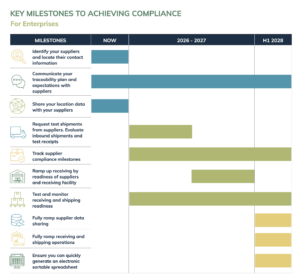
A milestone-based roadmap to help your organization move forward with confidence and meet FSMA 204 requirements by the enforcement date.
May 29, 2025
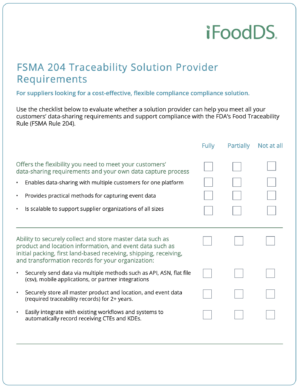
Use our checklist to evaluate whether a solution provider can support compliance with the FDA’s Food Traceability Rule (FSMA Rule 204).

November 27, 2024
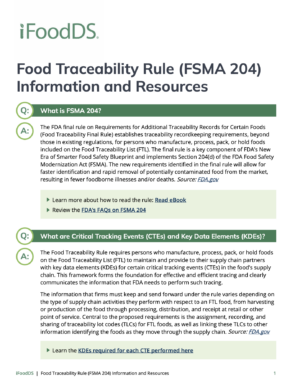
Check out our Timeline to FSMA 204 Compliance that walks you through the 4 critical steps to achieving end-to-end traceability: Learn, Plan, Do, Review.
May 2, 2024
Review our collection of FSMA 204 resources, guides, and templates developed by:
March 21, 2024
Obtén una mejor comprensión de los artículos que están cubiertos revisando nuestro eBook Lista de Trazabilidad de Alimentos en Imágenes, y consulta el apéndice para una lista más completa.
December 13, 2023
In this white paper, by Dr. Bob Whitaker, a produce safety expert and veteran, you will learn about the outbreak investigations and outcomes, and how the timelines and outcomes may have been different had FSMA 204 been in place.
August 10, 2023
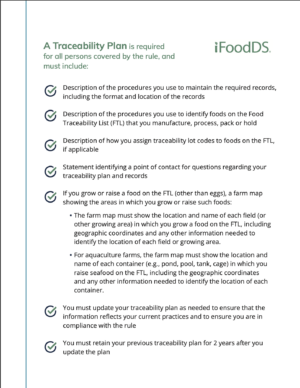
The Traceability Plan is a FSMA 204 requirement for all organizations across the supply chain who manufacture, process, pack or hold foods on the Food Traceability List (FTL). Download our Traceability Plan Requirements and Sample Plan infographic to guide your organization in creating your own Traceability Plan.
July 31, 2023
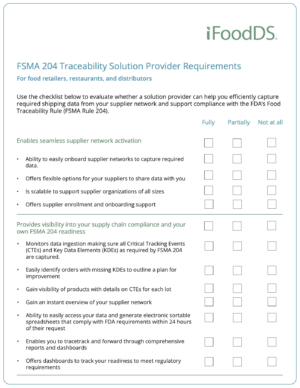
Use our checklist to evaluate whether a solution provider can support compliance with the FDA’s Food Traceability Rule (FSMA Rule 204).
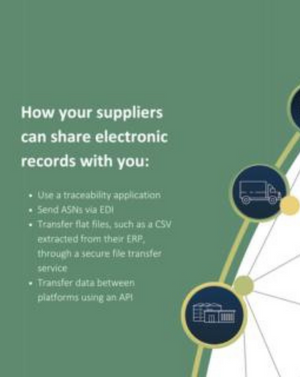
October 24, 2022
You’ll need the right information from your suppliers to record your Key Data Elements (KDEs). This infographic shows you ways to get that information so you can comply with Rule 204.
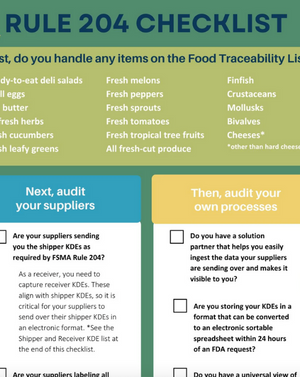
October 3, 2022
The rule will be finalized in November, 2022. Many companies will be subject to the new requirements and will have just 2 years to comply. Are you prepared? Go through our brief checklist to find out.
September 23, 2022
In this eBook, we explore the connection between traceability and enhanced food safety.
Click each question to expand.
What is the difference between FSMA 204 compliance and traceability readiness?
FSMA 204 compliance means meeting the regulatory requirements of the FDA Food Traceability Rule. Traceability readiness means having the people, processes, technology, and trading partner connections needed to consistently put those requirements into practice. An organization can be working toward compliance while still lacking the operational capabilities needed to reliably capture, manage, test, and electronically share traceability data.
A traceability-ready organization can:
Key takeaway: FSMA 204 compliance defines what records are required. Traceability readiness demonstrates your organization’s ability to consistently use, share, and retrieve those records in day-to-day operations.
How do I know if my company is truly FSMA 204-ready, and what are the most common traceability gaps to avoid?
A company isn’t truly FSMA 204-ready simply because it can collect traceability data. Readiness means being able to consistently capture, maintain, retrieve, and electronically share accurate traceability records across your operations and trading partners. Just as importantly, those processes have been tested—not simply documented.
Ask yourself these questions:
Some of the most common traceability gaps include inconsistent master data, incomplete or inaccurate traceability records, disconnected systems, limited testing, and relying on manual processes to exchange information across the supply chain. Identifying and resolving these gaps before they’re exposed during customer onboarding, traceability testing, or an FDA request gives organizations more time to refine their processes and build a repeatable, scalable traceability program.
Key takeaway: Traceability readiness isn’t measured by whether a plan exists—it’s measured by whether your people, processes, and technology can consistently support traceability in day-to-day operations.
Why are some customers requesting FSMA 204 traceability data before the enforcement deadline?
Many retailers, distributors, wholesalers, and foodservice organizations are already asking suppliers to begin participating in their FSMA 204 traceability programs—well before the enforcement deadline. Rather than waiting until compliance is required, they’re onboarding suppliers, testing electronic traceability data sharing, and validating readiness across their supply chains to identify and resolve gaps early.
Common reasons customers are starting early include:
Key takeaway: Early supplier onboarding reflects the reality that FSMA 204 readiness takes time. Companies that begin participating now have more time to validate data, test processes, resolve gaps, and meet both customer expectations and regulatory requirements.
How long does it take to become FSMA 204-ready, and what should organizations prioritize first?
For many organizations, FSMA 204 readiness takes 12–24 months because it involves much more than implementing new technology. Building a successful traceability program requires aligning people, processes, data, systems, suppliers, and customers—and validating that everything works together before the enforcement deadline.
While every organization’s journey is different, a practical readiness roadmap typically includes these key milestones:
Many retailers and distributors are already evaluating supplier readiness through onboarding programs and traceability testing. Programs such as TraceApproved™ can help suppliers build practical capabilities, demonstrate progress, and prepare for customer requirements while there’s still time to improve.
Key takeaway: Organizations that make steady progress through each phase of readiness are better positioned than those that wait until the enforcement deadline to begin.
👉 For a more detailed breakdown of what to prioritize at each stage, explore our FSMA 204 Readiness Roadmap, which outlines the key milestones organizations should complete before the enforcement deadline.
How should companies prepare for an FDA traceability records request, and how can they test their readiness before one occurs?
The best way to prepare for an FDA traceability records request is to test your traceability process before you need it. Organizations that regularly conduct mock trace exercises are more likely to identify gaps in their data, systems, and workflows while there’s still time to improve.
An effective readiness exercise should confirm that your organization can:
If testing reveals that your team is searching through spreadsheets, emails, paper records, or disconnected systems to assemble traceability information, it’s a sign that your processes may need refinement before an actual request occurs.
Key takeaway: Don’t let an FDA request—or a customer traceback exercise—be the first time you test your traceability program. Regular testing helps ensure your data, people, and processes are ready when they’re needed most.
What should a traceability label include to support FSMA 204 compliance?
FSMA 204 does not require a specific label format or labeling standard. Instead, it requires organizations to maintain and share the traceability records associated with a product. A well-designed traceability label helps connect the physical product to those records while supporting efficient data sharing across the supply chain.
For many fresh food suppliers, industry best practices include:
A traceability label is only one part of FSMA 204 readiness. Companies must also capture the required Key Data Elements (KDEs), maintain traceability records for applicable Critical Tracking Events (CTEs), and electronically share traceability data when required.
Key takeaway: A standardized traceability label helps connect products to their traceability records, but true FSMA 204 readiness depends on the quality of the underlying data and the processes used to manage and share it.
If my customer uses a specific traceability platform, do I need to use the same software?
Not necessarily. FSMA 204 does not require companies to use a specific traceability platform or software. In many cases, suppliers can continue using their existing ERP, WMS, traceability software, or other business systems—as long as they can capture the required traceability data and exchange it with customers in an accepted format.
Before adopting a new platform, ask:
Many retailers, distributors, and foodservice organizations have preferred onboarding processes or data-sharing methods, but that doesn’t necessarily mean suppliers must replace their existing systems. A scalable, interoperable approach allows organizations to exchange traceability data across different platforms while continuing to use the technology that best supports their business.
Key takeaway: The goal isn’t for every company to use the same software—it’s to ensure different systems can reliably exchange standardized traceability data across the food supply chain.
What capabilities should companies look for in a future-ready FSMA 204 traceability solution?
A future-ready traceability solution should do more than help you meet today’s compliance requirements. It should support a repeatable, scalable traceability program that can adapt as your business grows, customer expectations evolve, and new trading partners come online.
When evaluating a traceability solution, look for the ability to:
A future-ready traceability solution should help simplify operations—not create additional complexity. The goal is to establish one standardized process for capturing and sharing traceability data that can support both today’s requirements and tomorrow’s opportunities.
Key takeaway: Choose a traceability solution that grows with your business. The right platform should reduce manual work, support interoperability, and make it easier to serve multiple customers through one scalable approach.
Can companies use spreadsheets to comply with FSMA 204, and what are the risks of relying on spreadsheets, PDFs, and emailed documents?
Yes. The FDA does not require companies to use a specific traceability software platform, and spreadsheets may be sufficient for organizations with relatively simple operations or a limited number of trading partners. The more important question is whether your current approach will continue to support your business as your traceability program grows.
As operations become more complex, organizations often encounter challenges such as:
Spreadsheets can still be valuable for reporting and analysis, but many organizations find they become increasingly difficult to use as the primary system for collecting, managing, and sharing FSMA 204 traceability data.
Key takeaway: The goal isn’t to eliminate spreadsheets—it’s to ensure your traceability process remains accurate, efficient, and scalable as your business and customer requirements grow.
How can suppliers share FSMA 204 traceability data with multiple customers that have different requirements?
Many suppliers can capture FSMA 204 traceability data, but sharing that data with multiple retailers, distributors, and foodservice customers is often the greater challenge. While the FDA establishes the minimum traceability requirements, individual customers may have different onboarding processes, data formats, integration methods, or additional business requirements.
A scalable approach should:
Rather than creating separate workflows for every customer, suppliers should focus on standardizing how traceability data is captured and managed internally. Technology should adapt to customer requirements—not require your business to reinvent its processes for every new trading partner.
Key takeaway: The most scalable approach is to build one repeatable traceability process that can support many customers, rather than a different process for every customer.
How can companies onboard hundreds of suppliers for FSMA 204 without creating months of manual work?
For many retailers, distributors, wholesalers, and foodservice organizations, supplier onboarding is one of the most time-consuming parts of FSMA 204 readiness. The most successful organizations avoid treating each supplier as a separate project. Instead, they establish a standardized onboarding process that can be repeated across their supplier network.
A scalable supplier onboarding program should:
How do you know if suppliers are actually ready?
Supplier readiness should be demonstrated—not assumed. A supplier should be able to consistently capture, manage, and electronically share accurate traceability data, successfully complete testing, and repeat those processes as part of normal operations. Tracking these milestones provides a more meaningful measure of readiness than simply asking whether a supplier intends to comply.
What happens if a supplier can’t share FSMA 204 traceability data?
The impact depends on each customer’s requirements. Some organizations may work with suppliers to close readiness gaps, while others may require successful onboarding, test data sharing, or demonstrated traceability capabilities before moving forward with certain business requirements. That’s why many companies are beginning supplier onboarding well before the enforcement deadline.
Programs such as TraceApproved™ can help suppliers build and demonstrate traceability readiness through guided education, practical implementation activities, and a recognized readiness badge. This gives customers greater visibility into supplier progress while helping suppliers build capabilities they can use across multiple customer relationships.
Key takeaway: Standardizing supplier onboarding and validating readiness early helps organizations scale their traceability programs while reducing manual work and improving supplier participation.
1201 2nd Ave, Suite 915
Seattle, WA 98101
206-219-3703